

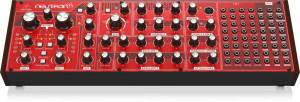
Behringer NEUTRON - analog synthesizer
You'll be redirected to supersound.pl
Description
A year and a half since Behringer first plunged into the analogue synthesis pool with the Deepmind 12, it is back with a (UK-designed) dual oscillator monophonic/paraphonic semi-modular synth, that can also be mounted in a Eurorack case for integration with an existing modular setup. A year and a half is a long time for a company, like Behringer, with such a large range. In that time, there’s been much speculation arising from some of the craftily spun ‘leaks’ that announced its intention to revisit a whole host of classic synths and drum machines, and reimagine them for the 21st century. The first fruits of this were the Model D, based on the legendary Minimoog. Of course, Behringer is no stranger to controversy when its comes to look and functionality (and its apparent resemblance to other competing products). However, like the Deepmind, the synth on review here is original in both look and feel. The Neutron’s front panel is of a distinctive red design, and appears to have been influenced (for better or worse) by synthesiser aesthetics of the 1990s. It features vintage Moog-style knobs with a 56-point mini-jack patchbay to the right. The rear panel hosts 1/4” jack sockets for line level audio in and out, and an associated headphone output. A USB socket is included for two-way MIDI communications, though parameter values can neither be transmitted or received. The MIDI THRU on the rear can, however, be pressed into service for creating multi-unit polyphony via the Polychain feature. There is also a MIDI input on the front panel, important if you wish to mount it in a modular Eurorack system.
The Neutron features two similar oscillators based around the V3340 VCO chip. This is a recreation of the famed CEM3340 found in a host of classic synths (see boxout). Both oscillators have a similar set of controls. The Range button switches between three different octaves. The Tune control provide +/- 1 octave of adjustment, but when all the Range buttons are lit, switches to a +/- 10 octave (with both low and high extremities inaudible to anything except a sub-bass loving mouse). This mode is perfect when using the Neutron as a standalone sound-effects generator. The oscillators can generate five different wave shapes, but there is more flexibility here than is first apparent. As you’d expect, Sine, Triangle, Sawtooth and Square (with independent Width control) are all present. However, an additional ‘Tone Mod’ setting allows you to dial in some additional, harmonically interesting, sonics. Here the Width control appears to adjust some kind of wave-shaping circuit. This isn’t quite the full picture, as the Shape control also allows you to move smoothly between adjacent wave shapes. This can even come under external control via the patchbay. Combined with oscillator Sync, a White Noise generator, and the ability to freely mix between the two sound sources, there is quite a bit of flexibility on offer. Usefully, you can also add an external audio source to the oscillator mix by plugging in to the rear panel audio input.
Once combined, all these elements are routed through the filter section. This has three primary filter modes all based around a 12dB/octave design. Fed by a simple square wave, we tested the filter in low-pass mode, and it shaped the sound in a largely satisfying way. Although a little less abrupt than most 24dB/octave designs, it provides quite a bit of bite. Turning the resonance up pushed the filter into self-oscillation which, with keyboard tracking engaged, generated a tone that was in tune across the keyboard. There is a secondary filter output on the patch bay which allows the creation of a notch filter alongside the switchable band, low and high-pass types. As the Neutron is a semi-modular design, there is a normalised routing for the various modulation sources. In this case the LFO is routed to control filter cutoff, and a Mod Depth control in this section determines its overall strength. At fast LFO (audio) rates this creates some further interesting tones. The patchable nature of the synth comes into its own when modulating the LFO rate and depth to control the strength and tonality of these newly created side-band frequencies. Envelope 2, a straightforward ADSR, is also routed to control filter cutoff (via the Envelope Depth control). For fast to medium sweeps this works well, though it would have been nice to have longer maximum attack, decay and release times. One issue that was particularly frustrating was the way in which even small amounts of resonance pushed the filter into saturation territory. It’s great to be able to access the dirtier side of things, but this shouldn’t be to the detriment of more conventional tones. Even with the overdrive section dialled down completely, the level from the oscillator section was hot enough to ruin the tonality of some sounds. In fact, it required routing the sign...