

Waldorf IRIDIUM - Synthesizer
You'll be redirected to supersound.pl
Description
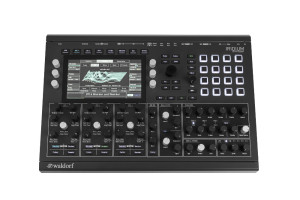
Waldorf Iridium – A New Era of Synthesis in Compact Form Waldorf Iridium brings the powerful Quantum synthesis engine into a compact desktop format. With 16 voices of polyphony, five synthesis engines, and full control over every parameter, Iridium redefines what a modern synthesizer can be – in the studio and on stage.
Main Features 16-voice polyphony – double the voices compared to Quantum 3 stereo oscillators per voice 5 synthesis engines: Wavetable, Waveform (VA), Particle (Sample & Granular), Resonator, Kernels 3 digital stereo filters per voice with various models (Nave, Largo, PPG, State Variable, Quantum) 16 performance pads (4×4) for triggering notes, chords, arpeggios, and sequences 6 LFOs, 6 envelopes, Komplex Modulator Advanced 40-slot modulation matrix 5 effect slots (chorus, flanger, phaser, reverb, overdrive, EQ, compressor) Step sequencer and polyphonic aftertouch via MIDI Import/export presets, samples, and settings via USB and microSD Powerful Synthesis Engine Iridium uses the same synthesis engine as the flagship Quantum. Each of the three oscillators can run in one of five modes: Wavetable for dynamic wave scanning, Waveform (VA) for classic analog-style sounds, Particle for sampling and granular manipulation, Resonator for rich spectral textures, and Kernels, which turns a single oscillator into up to six sub-oscillators combined with FM or AM.
Flexible Filters and Effects Each voice has three digital stereo filters that can be combined in various LP, HP, BP, and Notch configurations. Filter models include Nave, Largo, PPG, and more. The Digital Former section adds further tools like bitcrusher, ring modulation, comb filters, and drive. Five effect slots allow for flexible routing in parallel or series.
Advanced Modulation and Control With six LFOs, six envelopes, the Komplex Modulator, and a 40-slot modulation matrix, virtually any parameter can be modulated. The 16 performance pads allow triggering of chords, sequences, or notes, making Iridium just as powerful for live performance as it is for sound design.
User-Friendly Interface Most key parameters have dedicated knobs on the front panel, while the rest are easily accessed via a high-resolution color touch display. The workflow is streamlined to keep you focused on creating rather than menu diving.
Differences Compared to Quantum 16 voices of polyphony (Quantum – 8) 16 pads instead of a 61-key keyboard Digital stereo filters instead of analog 2 audio outputs instead of 4 Additional CV inputs for parameter modulation Technical Specifications 16-voice polyphony, duo-timbral 3 stereo oscillators per voice, each with 5 synthesis modes 3 stereo filters per voice (12/24 dB LP/HP/BP) 6 LFOs, 6 envelopes, Komplex Modulator 40-slot modulation matrix Polyphonic aftertouch via MIDI Step sequencer, arpeggiator 5 effect slots with parallel/serial routing Preset and sample management via USB and microSD Connectivity 2× stereo audio outputs (TS) 2× stereo audio inputs (TS) Headphone output with dedicated volume DIN MIDI In/Out/Thru USB-A (host), USB-B (device) microSD card slot 4 configurable CV inputs Gate In, Trigger In, Clock In/Out Design and Build Iridium features a rugged metal chassis, premium 24-bit A/D and D/A converters, and a sharp, full-color touch display. Its compact size and full integration with MIDI and CV make it the perfect choice for both professional studios and live performers.
Conclusion Waldorf Iridium offers the power of the Quantum in a smaller desktop format, with 16-voice polyphony, advanced modulation, and a streamlined interface. It is the perfect tool for professionals who demand maximum creative freedom and pristine sound quality.